How Many Smoke Detectors Do You Need?
House fires are a common occurrence in Florida. That’s not baseless conjecture but rather an unsettling reality documented in multiple studies, one of which was published by the Florida Department of Financial Services (FLDFS). It notes that there were an estimated 57,481 house fires in the Sunshine State in 2020.
Another study from the U.S. Fire Administration shows that house fires account for 5.8 deaths and 19.7 injuries per 1,000 fires in Florida. While not all house fires are preventable, installing and periodically inspecting smoke detectors can significantly reduce the risk of injury and death associated with them.
Common Causes of House Fires in Florida
Before delving into house fire alarms, which can minimize fire damage, save lives, and reduce the risk of fire-related injuries, let’s take a moment to highlight some of the most common causes of house fires in Florida.H
According to data from the City of Tampa, electrical issues account for a large proportion of house fires in Florida. Many of these fires are the result of lightning strikes, outdated wiring, overloaded circuits, faulty outlets, and damaged appliance cords. Cooking, improper use of space heaters, smoking, and careless or inappropriate use of candles are also common contributors to house fires across the state.
Why Smoke Detectors Are Worth the Investment
Investing in smoke detectors if your home doesn’t already have them is the single best thing you can do to keep you and your family safe. According to a National Fire Protection Association (NFPA) study, smoke detectors, also known as smoke alarms, reduce the risk of dying in a house fire by as much as 60%.
And that’s because they detect smoke and fumes before fire completely engulfs a home, which allows occupants enough time to escape with their lives.
Smoke alarms can also help minimize extensive property damage caused by a house fire by allowing occupants to call their local fire department sooner, which can keep repair costs from skyrocketing.
Lastly, having a smoke alarm can also help lower insurance premiums. Most home insurance providers offer discounts for homes with smoke detectors, especially those that are monitored and capable of sending a signal to a fire station or an alarm company central station when triggered.
How Many Smoke Detectors Does a Typical House Need?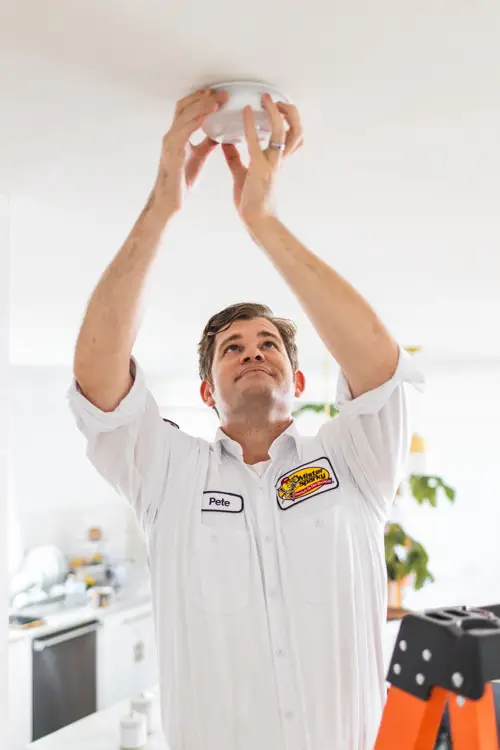
Having an adequate number of smoke alarms in a home is crucial for preserving life and minimizing structural damage in the event of a fire. According to NFPA 72 of the National Fire Alarm and Signaling Code, smoke alarms should be in every bedroom, outside all separate sleeping areas, and on every level of a home.
The National Fire Protection Association also recommends choosing alarms that have labels from Underwriters Laboratories (UL), Factory Mutual (FM) Laboratories, Intertek, and other recognized testing laboratories.
It also outlines the following for proper smoke alarm installation:
- Avoiding draft or airflow sources, like windows, doors, or air vents, when installing smoke alarms
- Ensuring ceiling-mounted smoke alarms are placed in the center of a room or at least 4 inches away from any wall
- Making sure any wall-mounted alarms are at least 12 inches away from the ceiling
- Making sure to install smoke alarms at least 10 feet away from a cooking appliance to lower the risk of false alarms
- Making sure to install smoke alarms within 3 feet of the peak, but not within the top 4 inches of the apex, in homes with sloped, vaulted, cathedral, or otherwise pinched ceilings
Ionization vs. Photoelectric Smoke Alarms: Which Is Right for Your Home?
Along with choosing how many and where to place smoke alarms in your home, choosing the right type is also an important decision. The two commonly used in residential homes are ionization and photoelectric alarm systems. Photoelectric smoke detectors use a light beam and a hidden sensor to detect smoke.
When smoke enters a photoelectric smoke alarm, it scatters the light like a bunch of small mirrors. That scattered light then reflects the beam onto the sensor, triggering an audible alarm. These alarms are highly effective at detecting slow, smoldering fires, like those caused by a cigarette being left on a sofa or mattress, for example, before they can burst into flames.
Meanwhile, ionization smoke detectors use radioactive material to create a steady electric current in the air. When smoke enters these systems, it breaks that electrical current, triggering an audible alarm. Ionization detectors are excellent at detecting fast-moving, flaming fires. Examples include grease, dryer lint, and candle fires.
For maximum safety, most fire experts recommend installing both ionization and photoelectric, alarm systems in a home.
Testing and Getting the Most out of Your Smoke Alarms
The best time to test and ensure a smoke alarm is working correctly is before a fire. One way to do that is to press the test button on each alarm in the home to see if it makes a sound. For battery-operated smoke alarms, homeowners should replace the batteries in each alarm every 6 to 12 months.
The same applies to hardwired alarms with battery backups. Both will make chirping sounds when the battery is low. It is also a good idea to follow the alarm manufacturer’s instructions for cleaning installed alarms. Periodic cleaning lowers the risk of premature sensor malfunctions and other problems.
How Interconnected Smoke Alarms Can Improve Home Safety
When you have multiple smoke alarms in your home, it only makes sense to have them all work collectively to help keep you and your family safe. That’s where an interconnected fire alarm system comes into the picture.
For reference, an interconnected fire alarm system is a system that triggers all alarms to sound when any of them detects smoke. Studies show that interconnected systems reduce fire damage and allow people to escape a home significantly faster than a single sounding alarm.
Hire a Niceville Electrician Today
To summarize, the number of smoke alarms that a home needs to keep occupants safe and minimize fire damage hinges on the home’s overall size. The effectiveness of those alarms also hinges on homeowners choosing the right systems and regularly servicing and testing them. To learn more or to schedule a service call, consider speaking with a Niceville Mister Sparky electrician today.